
Try your chair and keyboard position before buying a footrest. If your feet rest comfortably on the floor when the keyboard is within easy reach, start there. If a fixed-height desk makes you raise the chair until your feet lose support, a low platform may help. The fit depends on the position you actually use, and on what else is under the desk.
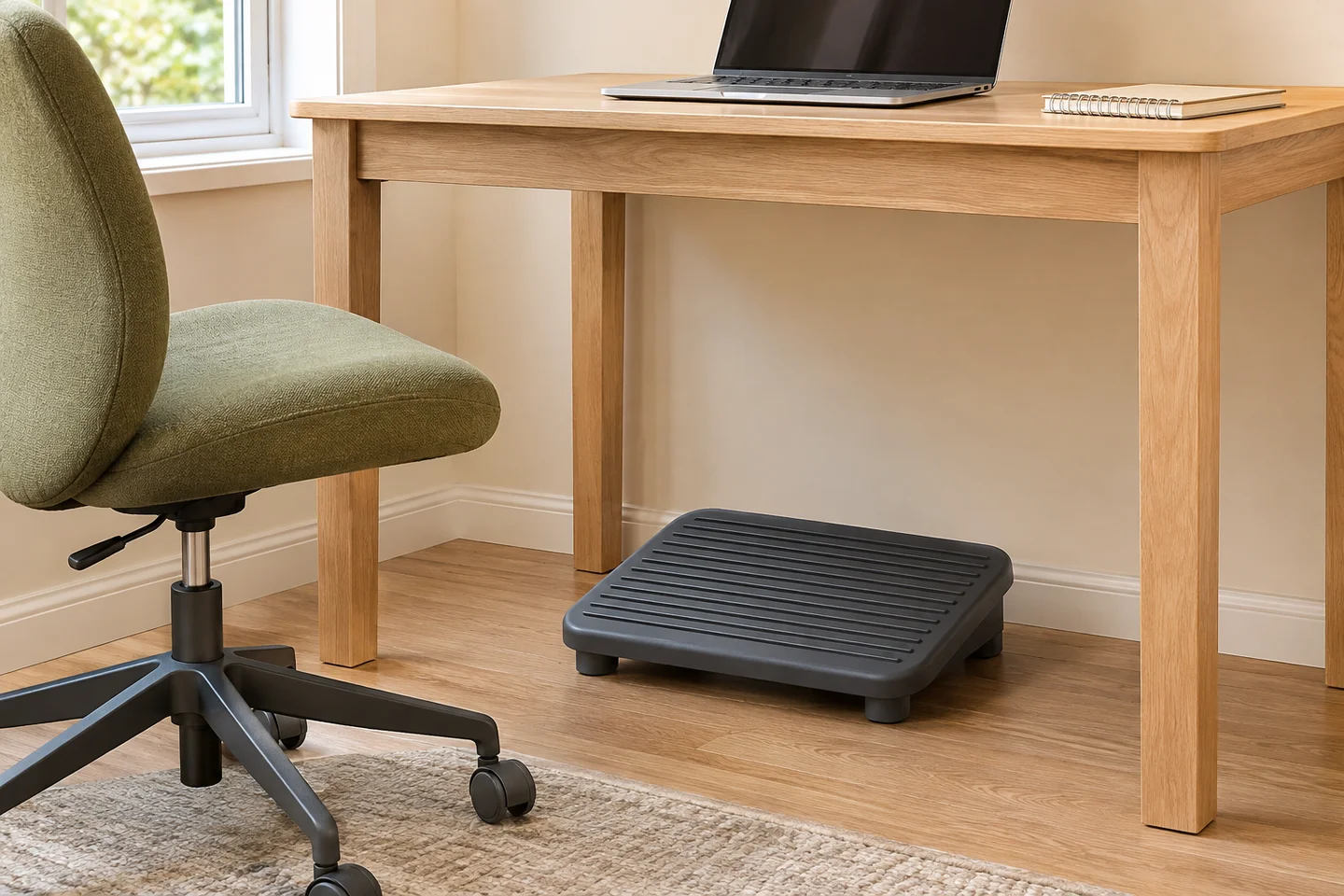
Test the chair and desk together
- Set your usual working height. Sit back in the chair, bring the keyboard within reach and let your shoulders relax. If you can lower the desk or the keyboard tray and still work comfortably with your feet supported, try that first.
- Check the gap. If your heels hang above the floor, try a rigid, stable low platform you already own. Sit normally, put both feet on it and see whether it reaches them without making you raise your knees uncomfortably.
- Measure from floor to support. Record the platform height where your feet actually rest. Also record its width and floor depth. An angled model might list its tallest point, which can differ from the height under your heels.
OSHA’s workstation guidance recommends supporting the feet fully on the floor or using a footrest when the desk height is fixed. See the workstation position guide.
Compare three footrest designs
| Design | Best for | Trade-off |
|---|---|---|
| Low fixed platform | One person with a chair position that stays the same | Simple to place, but the height stays fixed if you change chairs or switch shoes. |
| Height- or angle-adjustable platform | A shared desk or a setup you change often | Check the lowest setting and the space the base takes up. Confirm whether the angle locks or tilts freely. |
| Firm foam footrest | A lightweight alternative that is easy to move aside | Judge the height with your feet on it, since the foam can compress. Check whether the base slips on your floor. |
A clear area 18 inches wide and 14 inches deep can fit a base 16 inches wide and 11 inches deep on paper, leaving 2 inches across and 3 inches front to back. Before buying, mark that base on the floor and see whether you can roll the chair in and out without touching it. If the top surface is narrower than the base, verify that both feet still fit on it.
Check knee clearance and chair movement
Look for a crossbar, a low drawer, or cables where the platform needs to go. With your feet supported, check that your knees still clear the desk and that you can move your legs away easily when standing. Try the placement on your actual carpet or hard floor. Store the footrest to one side after work if leaving it centered prevents the chair from tucking in.
If the chair and desk still feel mismatched, check the small-desk chair fit guide. If an adjustable surface is an option, use the height-adjustable desk guide to check the seated range before comparing frames.
Set an example budget after the fit test
If the trial works and you want a dedicated footrest, a planning example is $25 for a basic platform or $45 for an adjustable one. Check current prices, dimensions and return terms before buying.
Compare small-desk footrests on Amazon US
Affiliate disclosure: As an Amazon Associate I earn from qualifying purchases.
- Compare low fixed footrests. Check actual height and usable width.
- Compare adjustable footrests. Look at the lowest setting, base depth and tilt mechanism.
- Compare firm foam footrests. Check firmness and the base material for your floor.