
If your desk shares a bedroom or living room, plan for the space it takes during work and where it goes afterward. A folding desk can give back a walkway, but only if the chair, equipment and folded desk each have somewhere to go.
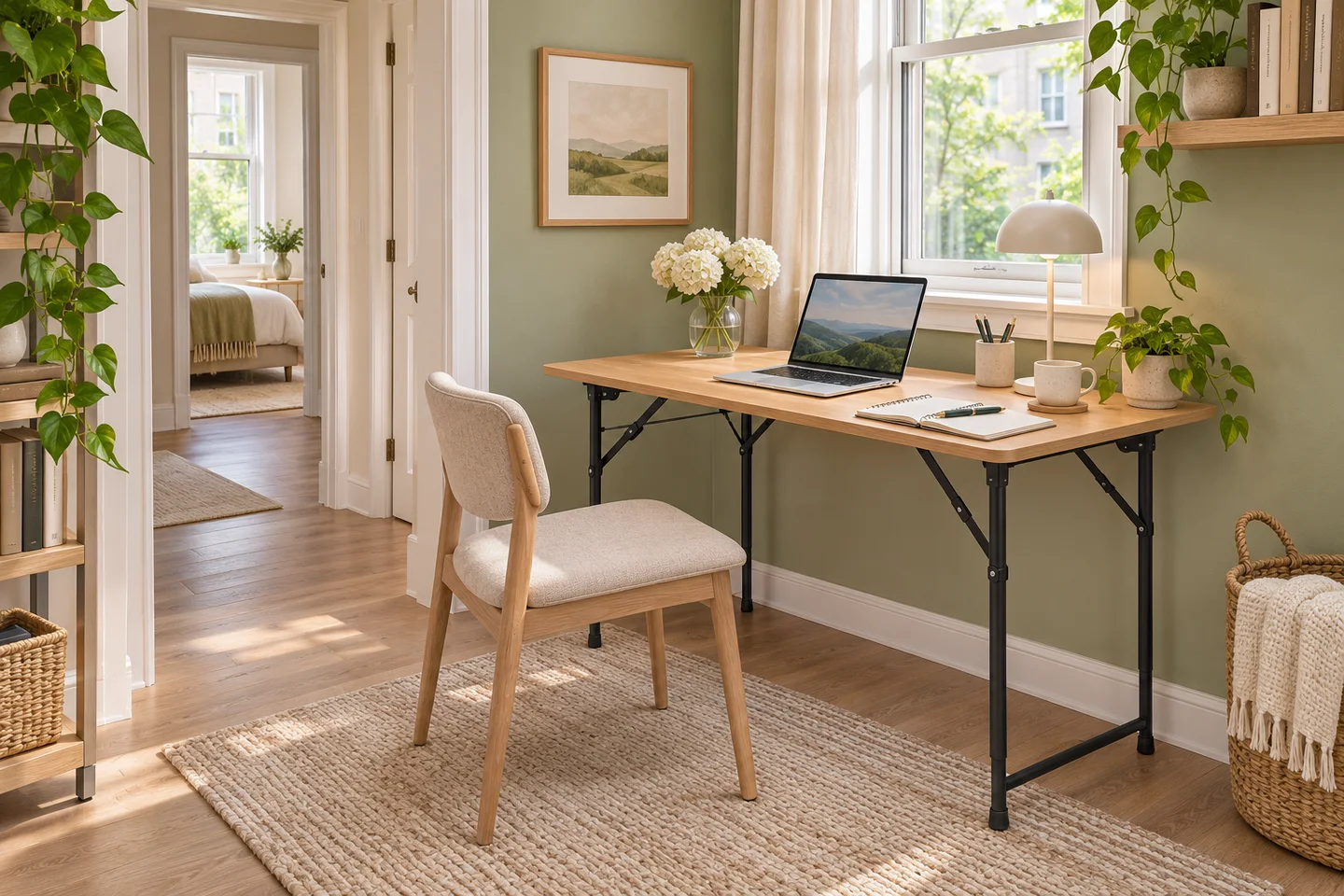
Measure the room with the desk open and closed
- Mock up the open surface. Start with a 32 × 18-inch rectangle as an example. Put your laptop, mouse and notebook inside it and check whether they all fit in your normal working positions.
- Test the chair and the doorway together. Pull the chair back as if standing up. Open the door or closet and walk the usual route. Measure the room you still need behind the chair while someone is seated. Check underneath the proposed desk for supports that would block your legs.
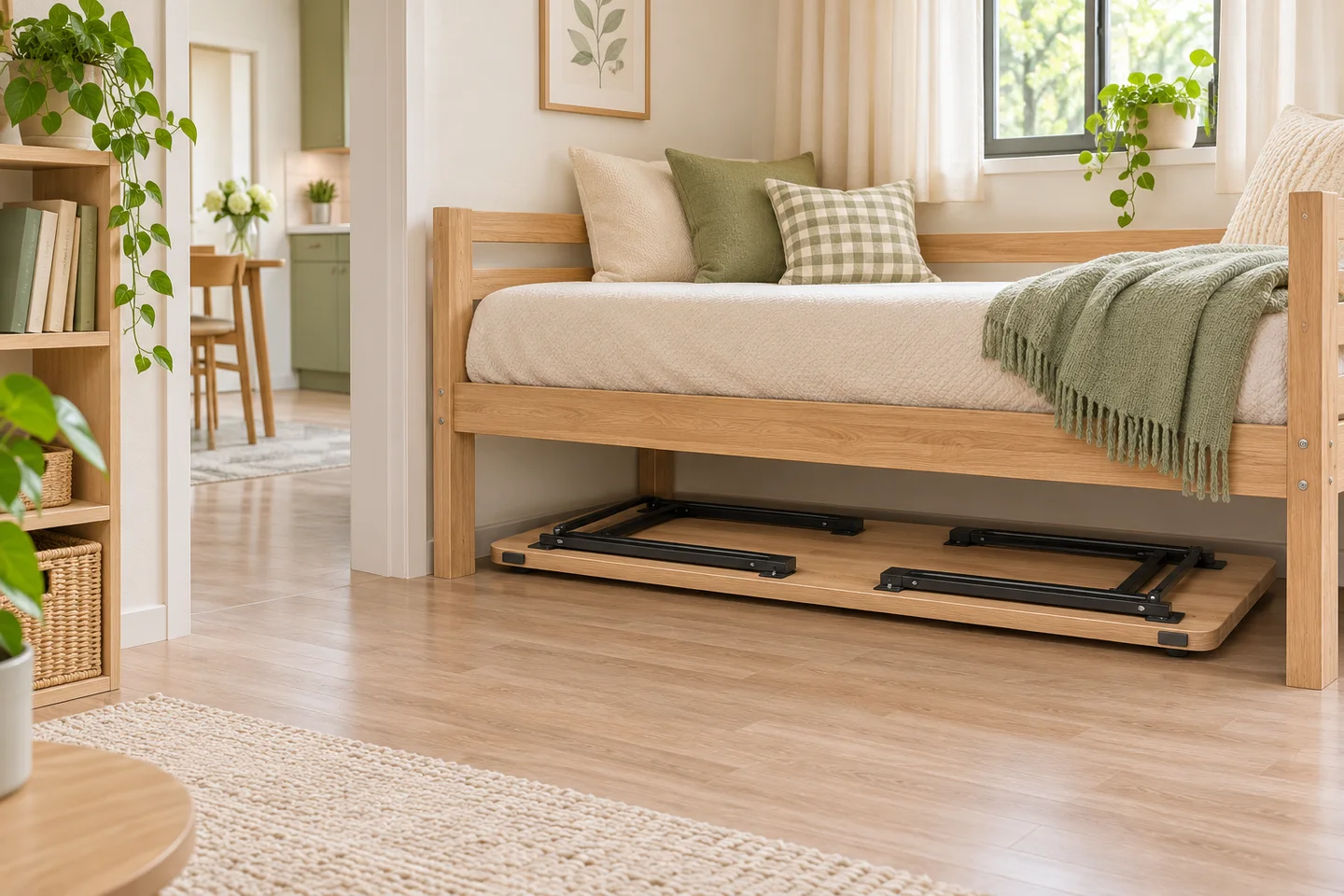
- Measure the folded shape. For a freestanding desk, record all three folded dimensions. If the listing shows a 32 × 18 × 4-inch folded desk and you have 5½ inches beneath a daybed, the opening leaves 1½ inches in height. Check the entire slide-in path, including drawers, beams and the direction you’ll approach from.
- Run the end-of-day routine. Put away the laptop, unplug the cable, fold the desk and move the chair, then check the walkway again. Decide where the charger and lamp will live after work.
Choose how the desk will fold
Freestanding folding desk
Good for a room where you can move the desk and have somewhere nearby to store it. Compare packed weight, grip points, folded thickness and the way the legs lock in the open position. Check whether the brace takes up knee space. If the folded desk is cumbersome to lift and carry, try a layout that can stay open along one wall.
Wall-mounted drop-leaf desk
Good for a regular work spot where floor space matters. It stays in one position and leaves a projection even when closed. Measure that depth, including the handle or latch, at the height where people walk past. Confirm permission to mount it and check the manufacturer’s installation instructions and load rating for your wall type before buying.
Wall-mounted desk with storage
Useful if you want pencils and a notebook to stay at the work spot. The box can project farther from the wall than a drop-leaf top. Check compartment depth and whether a laptop or charger fits without interfering with the closing mechanism.
Check legroom throughout your usual sitting positions. OSHA’s workstation guidance illustrates the difference between knee and foot clearance.
Budget for the entire setup
For an illustrative $180 planning budget, allocate $90 for the desk, $40 for seating if needed, $20 for task lighting and $30 for delivery, mounting or extras. Use the budget calculator with this $180 example to adjust those amounts. If you already have a chair, test it first using the chair clearance guide. See the fold-away layout sketch for a room plan you can mark out.
Compare folding desks on Amazon US
As an Amazon Associate I earn from qualifying purchases.
Compare current prices, open and closed dimensions, and the maker’s installation or storage guidance.
- Freestanding folding desks around 32 inches on Amazon US (paid link)
Check usable depth with your notebook and laptop together. - Freestanding folding desks that store flat on Amazon US (paid link)
Compare folded thickness, overall folded dimensions, weight and latch type. - Wall-mounted drop-leaf desks on Amazon US (paid link)
Check closed projection and the installation requirements for your wall. - Wall-mounted fold-down desks with storage on Amazon US (paid link)
Check compartment depth and what can stay inside when the desk closes. - Folding desks with enough depth for a laptop and notebook on Amazon US (paid link)
Compare usable desktop depth, including the space taken by any raised back edge.
Pingback: How to Choose a Desk for a Small Home Office
Pingback: Furinno vs. SHW: Compact Desk Comparison