
A shallow closet or recessed alcove can hold a laptop desk and leave the rest of the room free. Measure the opening, the chair and the space outside the recess before you shop. Those measurements tell you whether you can use the desk with the doors open and close them at the end of the day.
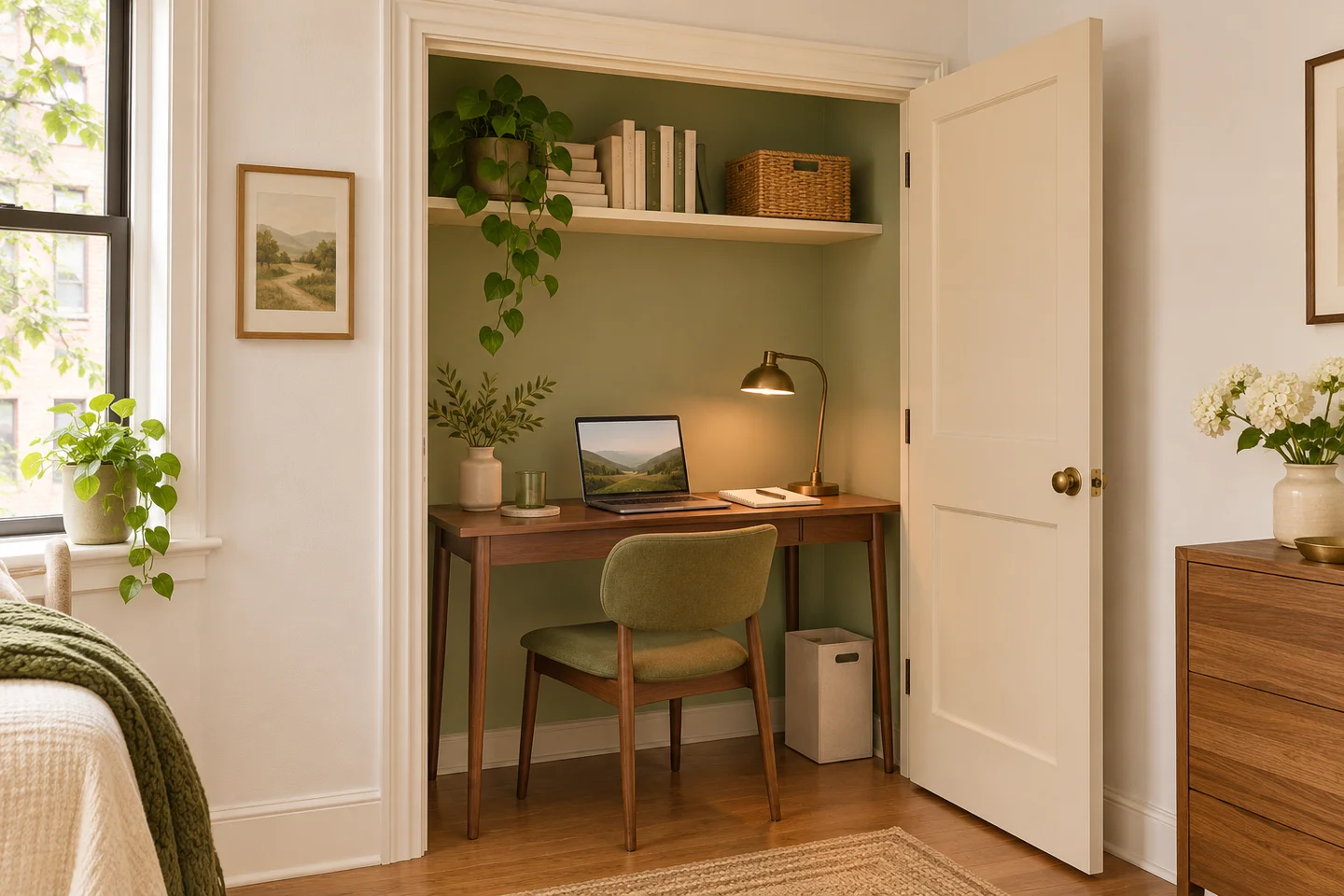
Measure the opening and the room outside it
- Clear opening. Open the doors as you normally would and measure between the closest obstacles, including hinges or folded door panels. Measure at desktop height and again at the floor.
- Usable depth. Measure from the back wall to the inside face of the closed door. Account for baseboards, plugs and anything that holds the desk away from the wall.
- Chair and walkway. Sit down where the desk will go. Mark the furthest point the chair reaches when you get up, then test the remaining route with the doors open. If someone regularly passes this spot, have them walk through during your trial.
Across: 36 in. clear opening − 32 in. desk = 4 in. total spare width.
Front to back: 25 in. usable depth − 18 in. desk − 2 in. at the wall for connections = 5 in. ahead of the desk inside the recess.
If your occupied chair reaches 24 in. past the desk edge, it projects 19 in. into the room in this example. Mark that point outside the opening before ordering.
Compare three ways to set up the space
| Setup | Best for | Trade-off |
|---|---|---|
| Freestanding writing desk | Daily laptop work and rentals where you want a removable setup | Crossbars and drawers can cut into the space for your chair and knees. |
| Freestanding folding desk | Occasional work in a recess that still serves another purpose | Check open and folded dimensions and the position of the supporting legs. |
| Desk just outside the opening | A recess too shallow for a comfortable desk and chair | You keep the recess for storage, but the work surface stays visible when the door closes. |
Test the chair, light and power before buying
Compare the chair’s widest point, including the base or arms, with the space between the desk legs. Check knee height below any drawer. If you want the chair tucked fully behind a closed door, measure from the front of the base to the backrest at the chair height you actually use.
Put the lamp opposite your writing hand and open a notebook where you intend to write. Adjust its head until it lights the page without reflecting on the screen. Check that the laptop and charger fit without pinching a cable behind the desk or running one across the door opening. If the recess feels hot or stuffy after a short trial, try the desk outside the opening.
Plan an example $185 budget
Set aside $85 for a desk, $65 for a chair, $20 for lighting and $15 for storage. These are planning allowances in US dollars. Current prices, delivery and taxes can change the total. If a chair you own fits the taped-out layout, keep it and put the difference toward the desk or save it.
Load the $185 example in the budget calculator to adjust the amounts for your setup.
Use the workspace measurement worksheet to record the opening, door swing and walkway. For removable storage and cable organization, see the no-drill home office guide.
Working with a sloped recess? The under-stairs home office guide shows where to test headroom and place the chair.
Compare closet office options on Amazon US
Affiliate disclosure: As an Amazon Associate I earn from qualifying purchases.
- Compact writing desks. Verify the assembled width and the distance between its legs.
- Armless desk chairs. Compare the full width of the base and the seat height range.
- Small adjustable desk lamps. Compare base size and how far the lamp head can reach.
- Slim office storage bins. Measure the space remaining beside the chair after you tuck it in.